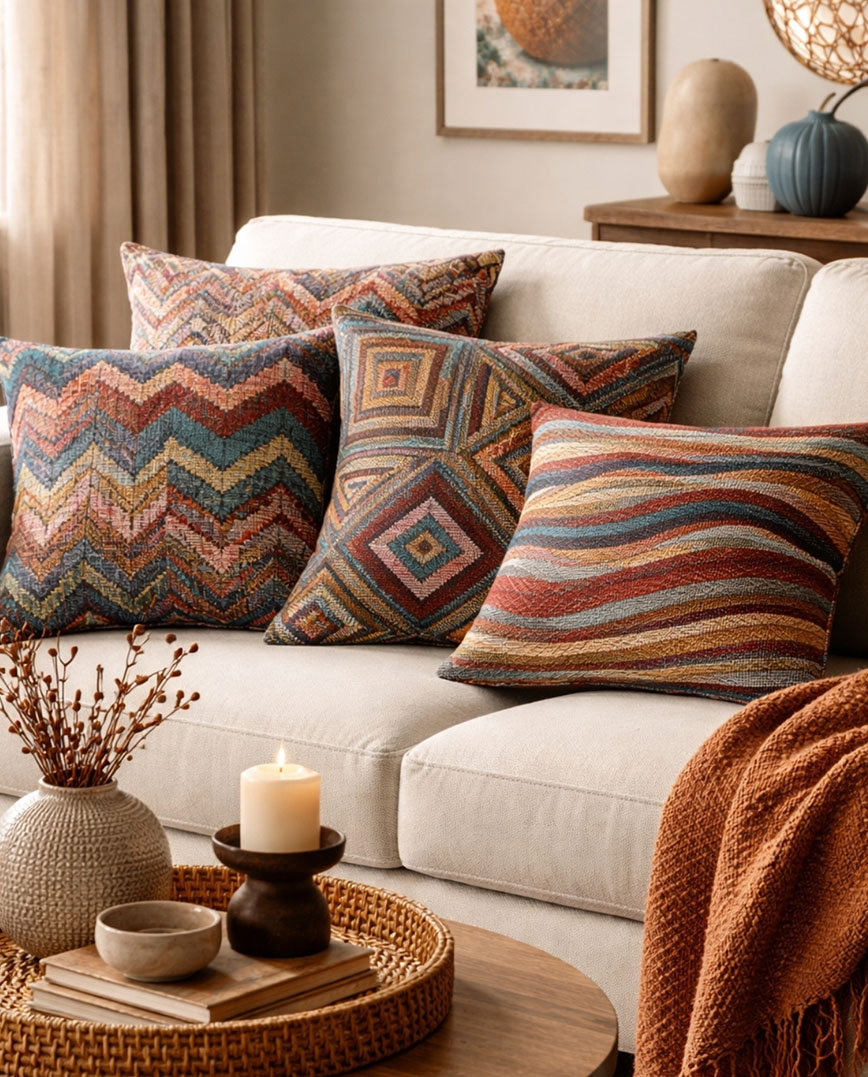
Jacquard is a fabric in which the pattern or texture is created within the fabric itself during weaving or knitting, rather than being printed onto the surface. As a result, jacquard can range from subtle and fluid to rich, structured and pronounced. The exact composition, thickness and intended use vary by quality.
Jacquard refers to the way a pattern or texture is created in the fabric. The design is formed during weaving or knitting and is therefore an integral part of the fabric itself.
Jacquard is therefore not a specific fibre composition or one single type of fabric. Composition, weight, drape, sheen and stretch can vary considerably between qualities.
Where does the name Jacquard come from?
Jacquard is named after the French weaver and inventorJoseph Marie Jacquard (1752–1834). Around the beginning of the 19th century, he developed a mechanism that allowed individual warp threads to be controlled during weaving. This made it possible to weave complex patterns directly into fabric far more efficiently. His name ultimately became associated with this method of pattern weaving.
Variations by Quality
Possible Variations
CompositionVaries by quality
PatternWoven or knitted in
DrapeFrom fluid to structured
FinishingFrom matt to lustrous
Important: jacquard describes the construction and does not automatically indicate composition or suitability. Always check the individual product for composition, width, weight, stretch and care instructions.
Uses & Selection
What is Jacquard used for?
ClothingDepending on weight and drape, it can be used for jackets, skirts, dresses, trousers and other garments.
AccessoriesFor bags, pouches and accessories when the chosen quality provides sufficient structure.
InteriorsMore structured qualities can be suitable for cushions and decorative interior projects.
DecorationFor applications where a woven-in pattern, texture or rich textile appearance is desired.
Choosing the right quality: do not choose jacquard on pattern alone. Weight, drape, stretch, composition and durability determine whether a quality is suitable for clothing, accessories or interiors.
Care
Care Instructions
Pre-washingOften recommended before sewing for cotton-rich qualities
WashingWash according to the instructions for the chosen quality
DryingPreferably air dry, or follow the individual product instructions
BleachingOnly when permitted by the individual product instructions
Good to Know
Sewing & Choosing
ShrinkageCotton-rich jacquard may shrink during the first washes and develop more pronounced texture.
CuttingLay the fabric flat without tension and use sharp cutting tools to reduce shifting and distortion.
SewingUse a fine to universal needle suited to the fabric weight and test stitch length and tension on an offcut.
FinishingNeaten cut edges if the quality frays; with very lightweight fabric this can also help reduce distortion.
Texture after WashingJacquard can develop a more pronounced crinkled or waffle-like texture after washing; this is characteristic of many qualities.
Choosing a QualityCompare composition, layer construction, weight, transparency and drape for each quality.
Frequently Asked Questions
Jacquard FAQs
Is Jacquard a material?
No. Jacquard refers to the technique or construction used to create the pattern within the fabric. The fibre composition can vary by quality.
Is Jacquard always thick and heavy?
No. Jacquard is available in lightweight, fluid qualities as well as heavy, structured ones. Weight and drape vary by quality.
Is Jacquard suitable for clothing?
Many jacquard qualities are suitable for clothing, but not all. Consider weight, drape, stretch, composition and the intended garment style.
What is the difference between Jacquard and printed fabric?
With jacquard, the pattern is formed by the construction of the fabric itself. With printed fabric, the design is applied to the surface.
Collection
Looking to Buy Jacquard?
Explore the available jacquard qualities, patterns and current product specifications.
Mutsaers Textiles uses cookies to improve your experience. By clicking “Accept”, you consent to the use of ALL the cookies. However you may visit Cookie Settings to provide a controlled consent.
Mutsaers TextilesAI Assistant
Search by:
How can I help? For example: I am looking for yellow jersey fabric.
 Custom fabrics
  Quantity discount
  Reorder easily